
Relative humidity vs absolute humidity comes down to one thing: relative humidity measures how full the air is compared to what it could hold at that temperature, while absolute humidity measures the actual amount of water vapor in the air, period. They can move in opposite directions at the same time — which is why a “70% humidity” day in January feels nothing like a “70% humidity” day in July.
In short, the difference between relative humidity and absolute humidity comes down to what each one measures: relative humidity is a percentage of the air’s maximum moisture capacity at that temperature, while absolute humidity is a fixed measurement of the water vapor’s mass in the air.
This guide breaks down what each term actually measures, how they relate to dew point, and which number is worth paying attention to when you’re managing comfort or mold risk at home. For target ranges by room, see our humidity levels by room guide.
What Is Absolute Humidity?
Absolute humidity is the actual mass of water vapor in a given volume of air, usually measured in grams per cubic meter (g/m3). It’s a fixed physical quantity — it doesn’t change just because the temperature changes. If you seal a room and heat it up, the absolute humidity stays the same; you haven’t added or removed any water molecules, you’ve just changed the temperature. For more on how water vapor behaves in air, see the UCAR Center for Science Education’s overview of humidity.
What Is Relative Humidity?
Relative humidity is the percentage most people see on a weather app or hygrometer. It compares the actual water vapor in the air (absolute humidity) to the maximum the air could hold at its current temperature, then expresses that as a percentage. Warm air can hold far more water vapor than cold air, so the same absolute humidity produces a much lower relative humidity reading when the air is warm, and a much higher one when it’s cold.
Relative Humidity vs Absolute Humidity: The Core Difference
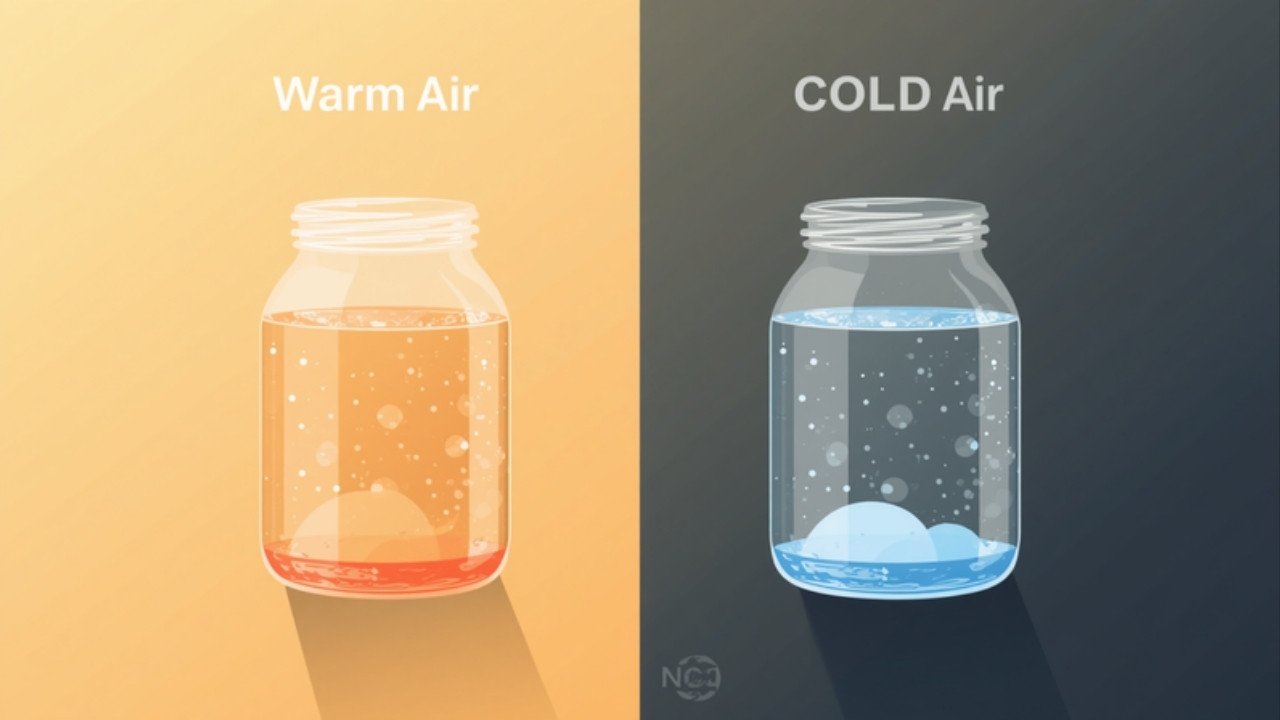
Here’s the difference in practice: imagine a sealed room holding a constant 8.5 grams of water vapor per cubic meter — its absolute humidity never moves. At 50°F (10°C), the air can only hold about 9.4 g/m³ of water vapor before it’s fully saturated, so relative humidity reads close to 90%. Heat that same room to 80°F (27°C) without adding any moisture, and the air’s capacity rises to roughly 25 g/m³, so relative humidity falls to around 34% — because warm air can hold far more water vapor than cold air. Nothing about the actual moisture changed — only the air’s capacity did.
This is exactly why heating cold winter air makes a house feel dry: bringing in cold outdoor air (low absolute humidity) and warming it up drops the relative humidity even further, since the air’s capacity increases while the actual moisture stays fixed. It’s also why our ideal humidity level guide recommends the 30-50% relative humidity range — a threshold consistent with the EPA’s guidance on indoor moisture control — rather than a fixed absolute number — comfort and mold risk both depend on the temperature-relative reading, not the raw moisture count.
Where Dew Point Fits In
Dew point is a third way to describe humidity, and it’s arguably the most useful one for gauging how muggy the air actually feels. Per the National Weather Service, dew point is the temperature air must cool to before it becomes saturated and water starts condensing out. Unlike relative humidity, dew point doesn’t swing with the current temperature — a dew point in the 50s feels comfortable, 60-65 starts to feel sticky, and anything above 65 feels muggy, regardless of the air temperature that day.
Dew point tracks absolute humidity far more closely than relative humidity does, which is why meteorologists increasingly use it to describe how the air actually feels, rather than relative humidity alone.
Which One Should You Actually Look At?
For home comfort and mold prevention, relative humidity is the number that matters — it’s what your hygrometer reads — see our guide on how to calibrate a hygrometer at home to make sure yours is accurate — and it’s what building science guidance (30-50% indoors) is based on. Absolute humidity is more useful for HVAC engineering and meteorology, where the actual moisture load in the air needs to be calculated independent of temperature. Dew point is worth checking when you want an intuitive read on how the air will actually feel, especially outdoors.
Bottom Line
Relative humidity vs absolute humidity isn’t a matter of one being more “correct” — they measure different things. Absolute humidity is the fixed amount of water vapor in the air; relative humidity is that amount expressed as a percentage of what the air could hold at its current temperature. For everyday home humidity control, keep watching relative humidity — it’s the number tied to comfort, mold risk, and the ranges most guidance is built around.
Related reading: Why Does My House Feel Humid Even With the AC On? and How Humidity Affects Your Skin and Hair.
What is the difference between relative humidity and absolute humidity?
Absolute humidity measures the actual mass of water vapor in the air (g/m3) and doesn’t change with temperature. Relative humidity expresses that same water vapor as a percentage of what the air could hold at its current temperature, so it changes constantly as temperature changes.
Why does relative humidity change when absolute humidity stays the same?
Because warm air can hold more water vapor than cold air. If the actual amount of moisture (absolute humidity) stays fixed but you heat or cool the air, the air’s capacity changes, which changes the relative humidity percentage even though no moisture was added or removed.
Is dew point the same as absolute humidity?
Not exactly, but they’re closely related. Dew point is a temperature (the point at which air becomes saturated), while absolute humidity is a mass measurement (grams of water vapor per cubic meter). Both stay more consistent than relative humidity as temperature changes.
Which humidity measurement should I use at home?
Relative humidity is the one that matters for comfort and mold prevention indoors. It’s what hygrometers measure and what the recommended 30-50% indoor range is based on.
Why does my house feel dry in winter even at the same humidity percentage?
Cold outdoor air has very low absolute humidity. When that air is heated indoors, its capacity to hold moisture increases while the actual water vapor stays the same, so relative humidity drops sharply, leaving the air feeling drier even if the percentage reading seems similar to other seasons.