
How long should you run a humidifier each day? As a general guideline, 8-12 hours during dry winter months and 6-8 hours during milder or more humid seasons covers most homes, but the better approach is running it until a hygrometer shows you’ve hit the 30-50% target range, then letting it cycle on and off from there rather than fixating on a specific hour count.
Why a Fixed Number of Hours Isn’t the Real Answer
Every home loses or holds moisture differently depending on square footage, insulation, ventilation, outdoor climate, and even how many people and pets are inside generating humidity from breathing and cooking. A small, well-sealed bedroom might reach comfortable humidity in two or three hours, while a large, drafty living room could need the better part of a day. Rather than running a humidifier for a fixed number of hours regardless of conditions, the more reliable method is watching a hygrometer and adjusting runtime to hit and hold the 30-50% ideal humidity range.
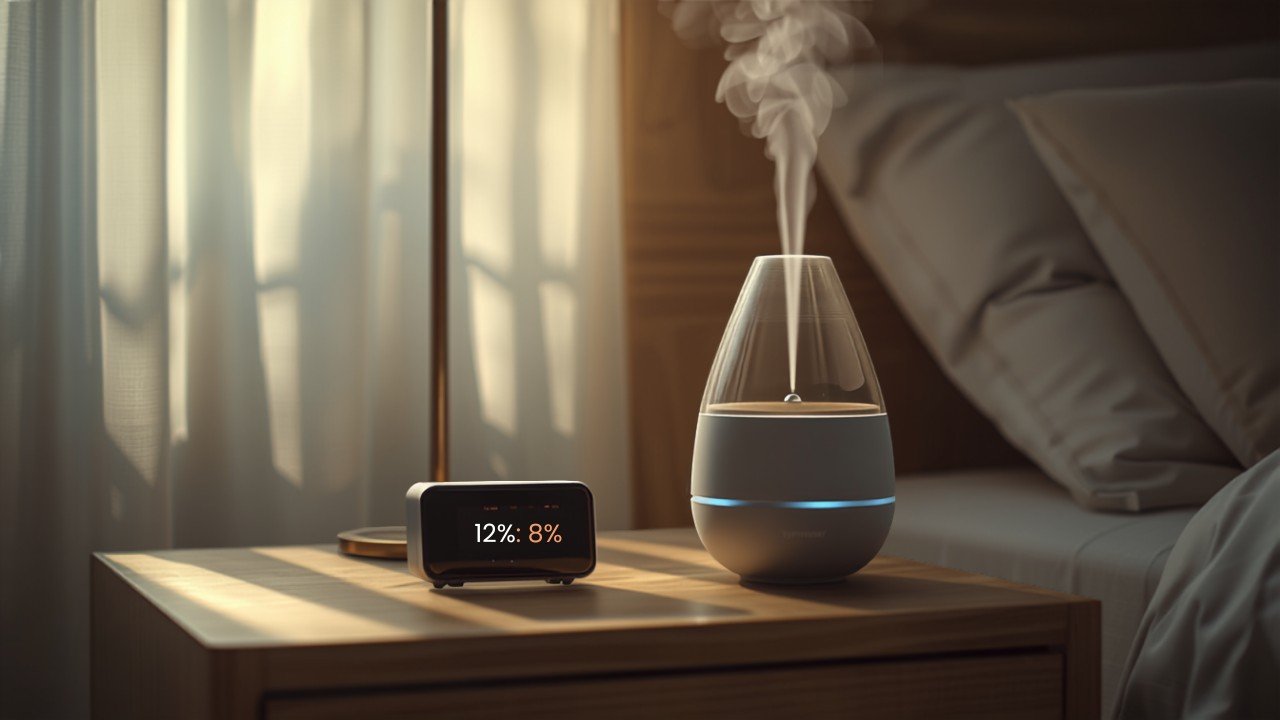
Seasonal Guidelines That Work as a Starting Point
- Winter/dry climates: 8-12 hours daily is a reasonable starting point, since heated indoor air holds much less moisture than summer air.
- Spring/fall/moderate climates: 6-8 hours daily is usually enough to maintain comfort without overshooting.
- Already-humid climates or homes: less runtime, or a humidifier may not be needed at all — check your baseline with a hygrometer first.
- Overnight/bedroom use: 8-10 hours covers a typical sleep window and is one of the most common, generally safe use patterns.
Running a Humidifier Overnight
Running a humidifier through a full night’s sleep is extremely common and generally considered safe, particularly for easing dry throats, nasal congestion, and dry skin that tend to worsen overnight in heated bedrooms, effects Mayo Clinic also notes humidifiers can help ease. The main practical considerations are making sure the tank has enough capacity to last the whole night without running dry, and keeping the unit on a regular cleaning schedule since it will be running unattended for hours at a stretch — EPA guidance recommends emptying and refilling the tank daily and cleaning portable units every third day to limit microbial growth.
Why Continuous 24-Hour Operation Usually Isn’t Recommended
Running a humidifier nonstop, around the clock, without any automatic shutoff risks pushing humidity well past the healthy 30-50% range — a target range that EPA also recommends maintaining in its indoor air quality design guidance — especially in smaller or well-insulated rooms. According to EPA guidance on moisture and mold, sustained indoor humidity above roughly 60% creates conditions that actively support mold and dust mite growth, along with window condensation and musty odors. If you want to run a humidifier for extended or continuous periods, using a model with a built-in humidistat that automatically cycles off once target humidity is reached removes the guesswork and the risk.

Practical Factors Beyond Just Hours
- Tank size: a small 0.5-gallon tank may not last a full 8-10 hour overnight run at higher mist settings, while a 1.5-2 gallon tank typically will.
- Room size: larger or more open rooms take longer to reach target humidity and may need proportionally longer runtime or a higher-capacity unit.
- Outdoor weather: colder outdoor temperatures mean drier heated indoor air, which typically pushes actual needed runtime toward the higher end of the range.
- Household size and activity: more people, pets, cooking, and showering all add ambient moisture, which can reduce how long the humidifier itself needs to run to hit target humidity.
It’s also worth noting that runtime and mist intensity work together — a humidifier set to a high mist output for a shorter period can reach the same humidity target as one set to a lower output running longer, so the “hours per day” question is really shorthand for “how much moisture does this room need,” which a hygrometer answers far more precisely than a fixed schedule ever could.
Using a Hygrometer to Set the Real Schedule
The single most useful tool for answering “how long should I run this” is a basic hygrometer placed in the same room as the humidifier, away from direct airflow from the unit itself for an accurate reading. Run the humidifier, check the hygrometer periodically, and once the room holds steady in the 30-50% range, you’ve found your actual runtime for that room and season — which will naturally shift as outdoor weather and indoor heating patterns change throughout the year.
How Runtime Differs by Humidifier Type
Ultrasonic humidifiers typically have smaller tanks relative to their mist output, so an overnight 8-10 hour run may require a larger-capacity model or a mid-night refill for bigger rooms. Evaporative humidifiers, which pull air through a wet wick, naturally self-limit somewhat since output slows as the wick dries, making them a bit more forgiving of extended runtime without a humidistat. Steam vaporizers use more electricity per hour of continuous operation because they’re actively heating water, which is worth factoring in if you’re planning very long daily runtimes rather than just overnight use.
Adjusting Runtime Room by Room
A whole-house humidifier tied to the HVAC system behaves differently from a portable unit in a single bedroom, since it’s distributing moisture across a much larger volume of air and typically runs on its own automated schedule tied to a central humidistat. For portable units, it’s worth treating each room individually rather than assuming the same runtime applies everywhere in the house — a small nursery or bedroom will often reach target humidity in a fraction of the time a larger open-plan living area needs, so check each room’s actual reading rather than defaulting to one universal schedule.
Signs You’re Running It Too Long
- Visible condensation or fogging on windows, especially in the morning.
- A musty or damp smell developing in the room.
- Surfaces near the humidifier feeling consistently damp or clammy.
- A hygrometer reading consistently above 50-55% even hours after the unit has been running.
If any of these show up, cut back on runtime and recheck with the hygrometer rather than assuming the fixed hourly guideline is correct for your specific space. For a broader look at how different rooms in a home should be treated differently, our humidity levels by room guide breaks down targets room by room.
Related reading: How to Choose the Right Humidifier for Your Bedroom and Cool Mist vs. Warm Mist Humidifier: Which Is Better?.
How long should you run a humidifier each day?
Most homes do well with 8-12 hours during dry winter months, and 6-8 hours during milder or already-humid seasons. The right duration depends less on a fixed number of hours and more on hitting and holding a 30-50% indoor humidity level.
Is it safe to run a humidifier all night while sleeping?
Yes, running a humidifier for a full 8-10 hour overnight stretch is one of the most common and generally safe use patterns, especially for dry throats, congestion, and skin comfort. Just make sure the unit has enough water capacity for the full night and is cleaned on a regular schedule.
Can you run a humidifier continuously, 24 hours a day?
It’s generally not recommended without a built-in humidistat that automatically shuts off once target humidity is reached. Running continuously without that safeguard risks pushing humidity well past the 30-50% target and into the 60%+ range, which EPA guidance links to condensation, dust mites, and mold growth.
Do I need a hygrometer to know how long to run my humidifier?
It’s strongly recommended. A basic hygrometer lets you see the actual room humidity rather than guessing from a fixed schedule, so you can adjust runtime up or down based on real conditions rather than a generic hours-per-day rule.
Should I run my humidifier for the same number of hours in every room?
No. Rooms differ in size, airflow, and how much moisture they need — a small bedroom reaches target humidity much faster than an open living room, so runtime should be adjusted per room based on hygrometer readings rather than applied uniformly across the house.
What Happens if You Run It Too Little
Underrunning a humidifier is a less obvious problem than overdoing it, but it’s just as common — a unit that’s only on for an hour or two in a large, dry room during peak winter often barely nudges the humidity reading at all before shutting off, leaving occupants no better off than without one. If a hygrometer shows humidity staying stubbornly below 30% despite regular use, the issue is usually one of three things: the room is too large for the unit’s rated coverage area, the runtime is too short relative to how quickly the room loses moisture to a dry HVAC system, or the tank is running dry partway through the session. Before assuming a bigger or additional humidifier is needed, it’s worth first extending runtime and confirming the tank isn’t emptying early, since either of those is a much cheaper fix than a second unit.
Building a Simple Weekly Routine
Rather than treating humidifier runtime as a daily decision, it helps to settle on a routine for the season and revisit it only when conditions change noticeably — a cold snap, a change in heating settings, or a shift from winter to spring. Check the hygrometer once a day for the first week of a new season to dial in the right runtime, then spot-check weekly once the pattern is stable. This turns what could be a constant guessing game into a five-minute weekly check, while still catching any drift toward too dry or too damp before it becomes a comfort or mold problem.
Bottom Line
Start with 8-12 hours daily in winter or dry conditions and 6-8 hours in milder seasons as a baseline, but let a hygrometer — not the clock — be the real guide. Once a room holds steady in the 30-50% range, you’ve found the right runtime for that space, and it’s worth rechecking as the seasons change.