
As soon as the furnace kicks on for the season, dry indoor air becomes an annual autumn problem. Relative humidity indoors can drop sharply once heating season starts, leaving skin dry, wood floors and furniture creaking, and static shocks a daily annoyance. This is the moment every fall when homeowners land on the same fork in the road: install a whole-house humidifier that works with the furnace before the cold really sets in, or grab a portable unit for the room that needs it most, right now. Both raise indoor humidity, but they differ enormously in cost, installation, coverage, and upkeep. Here is how the two actually compare, so you can decide before winter arrives.
Two Different Ways to Solve the Same Problem
A whole-house humidifier is installed directly into a home’s ductwork or furnace by an HVAC technician. It draws water from a supply line and adds moisture to the air as it circulates through the heating system, so every room connected to the ducts gets treated at once. A portable humidifier, on the other hand, is a standalone appliance you place in a single room, plug into a wall outlet, and refill with water by hand. It treats only the space around it, but it needs no professional installation and can be moved from room to room as needs change.
Whole-House Humidifiers: Installation and Upfront Cost
Because a whole-house unit ties into the furnace and ductwork, it has to be installed by a qualified HVAC professional, typically in a few hours as part of a fall furnace tune-up. According to cost-guide data compiled by HomeGuide, a whole-house humidifier generally runs $400 to $1,200 installed, with higher-end steam models running as much as $2,200 depending on the type and features chosen. A separate breakdown from HVAC contractor Standard Heating splits that further into roughly $400 to $1,200 for the equipment itself and $300 to $700 for labor, depending on how accessible your ductwork is. It is a real up-front investment, but one that is typically made once every decade or so.
Portable Humidifiers: Setup and Upfront Cost
A portable humidifier requires no installation at all. You unbox it, fill the tank, plug it in, and it starts working within minutes. Most single-room models are inexpensive relative to a whole-house system, and larger console units built to cover more square footage cost more but still fall well short of installed whole-house pricing. The tradeoff for that low upfront cost and easy setup is that a portable unit only humidifies the room it sits in, and it needs regular refilling, which a ducted system does not.
Coverage Area: How Much of the House Actually Gets Humidified
Coverage is where the two options diverge the most. Per an ENERGY STAR market scoping report, whole-house furnace-mounted humidifiers are sized to the home and can effectively humidify houses up to roughly 6,000 square feet, since they distribute moisture through the same ducts that already heat every room. Portable humidifiers are designed to raise humidity in one room, a handful of rooms, or, with the largest console models, a small home of up to about 2,500 square feet. If dry air is a problem throughout your house, a single portable unit is not going to close that gap; if it is really just the bedroom or nursery that needs help, a portable is often all you need. For general guidance on choosing a unit sized to a single room, see our guide to picking the right bedroom humidifier.
Maintenance and Lifespan
Whole-house systems are largely “set and forget.” Most need a water panel or filter replacement about once a year, plus an occasional check for mineral buildup or leaks, and the same ENERGY STAR data cited above puts their typical service life at around 10 years or more with proper care. Portable humidifiers demand much more hands-on attention: tanks need refilling every day or two, and because standing water breeds mold, mineral scale, and bacteria quickly, the tank and wick or filter need cleaning far more often, ideally every few days to once a week. Skip that upkeep and you risk the exact problems we cover in how often you should clean your humidifier and whether a dirty humidifier can make you sick. Partly as a result of that harder duty cycle, portable units typically last only 3 to 5 years before needing replacement.
Whole-House vs. Portable Humidifier at a Glance
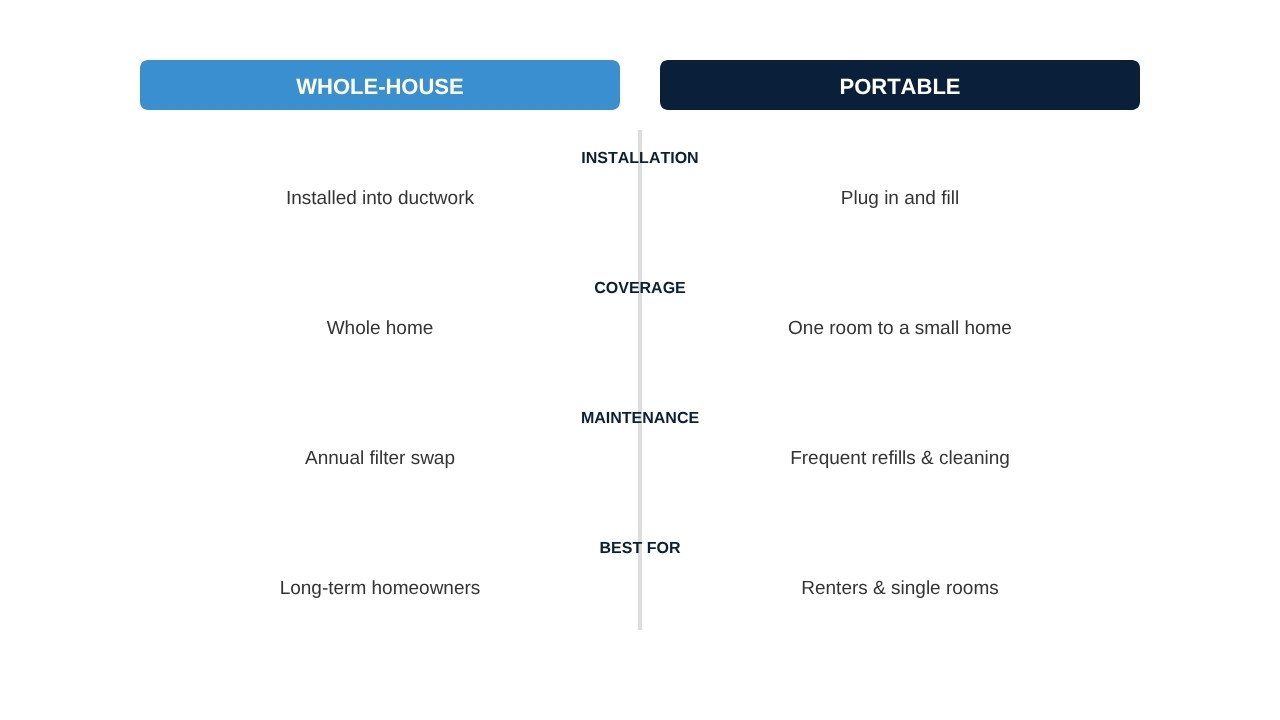
| Factor | Whole-House Humidifier | Portable Humidifier |
|---|---|---|
| Installation | Professionally installed into furnace/ductwork | None – plug in and fill |
| Upfront cost | Roughly $400–$2,200 installed | Low; larger console units cost more |
| Coverage area | Whole home, up to about 6,000 sq ft | One room to a small home, up to about 2,500 sq ft |
| Maintenance | Annual filter/panel swap; ~10-year lifespan | Frequent tank refills and cleaning; 3–5-year lifespan |
| Best for | Whole-house dryness, long-term homeowners, low daily upkeep | Renters, a single bedroom or nursery, tight budgets, quick fixes |
Which One Is Actually Right for You This Fall
Choose a whole-house humidifier if…
- Dry air, static shocks, or cracking woodwork show up in multiple rooms, not just one
- You own the home and plan to stay long enough for the investment to pay off
- You are already scheduling a fall furnace tune-up and can add the install to that visit
- You would rather handle maintenance once a year than clean a tank every few days
Choose a portable humidifier if…
- You rent, or otherwise cannot modify the HVAC system
- The problem is really just one room, like a bedroom or nursery
- You need relief now and cannot wait for an HVAC appointment
- Budget matters more than long-term convenience, at least for this season
Deciding between cool mist and warm mist matters too once you have settled on a portable unit; our cool mist vs. warm mist humidifier comparison breaks down which type suits allergies, young children, and different rooms in the house.
Keep Humidity in the Healthy Range Either Way
Whichever system you choose, the target does not change. The EPA recommends keeping indoor relative humidity between 30% and 50%, and never letting it sit above 60% for extended periods, since excess moisture encourages mold and dust mites. A whole-house system is usually paired with a humidistat that automates this, while a portable unit requires you to check a hygrometer and adjust the settings yourself. Either way, monitoring the number matters more than the type of machine producing it; our guide to the ideal humidity level for a home covers how to dial that in room by room.
Frequently Asked Questions
Is a whole-house humidifier worth the cost?
For homes with dry air throughout, most likely yes. A whole-house unit typically costs $400 to $2,200 installed but lasts around 10 years with minimal upkeep, humidifying every room automatically through the existing ductwork. Homeowners who plan to stay put and deal with whole-house dryness generally see it pay off in comfort and lower maintenance effort compared to running several portables.
Can a portable humidifier handle an entire house?
Only in limited cases. The largest console portable humidifiers can cover roughly up to 2,500 square feet under ideal conditions, but most models are built for one room. If dry air affects the whole house, a whole-house system or multiple portables placed strategically will work far better than a single portable unit.
How long does it take to install a whole-house humidifier?
A typical installation takes an HVAC technician just a few hours, and it is often scheduled alongside a routine fall furnace tune-up so the system is ready before heating season ramps up.
Do portable humidifiers really need cleaning that often?
Yes. Standing water in a tank can grow mold, bacteria, and mineral scale within days, so the tank, wick, and filter should be cleaned roughly every few days to once a week, more often than most people expect from a small appliance.
What humidity level should I aim for in my home?
The EPA recommends keeping indoor relative humidity between 30% and 50%, and avoiding sustained levels above 60%, regardless of whether you use a whole-house system or a portable unit.
Can I use a whole-house humidifier and a portable humidifier together?
Yes, and it is a common approach. Some homeowners run a whole-house system for baseline comfort and add a portable unit in a bedroom or nursery that needs extra humidity, such as during a cold or for a newborn.