
If you’ve noticed your hygrometer reading dropping every time a cold front rolls through this fall, you’re not imagining it. There’s a straightforward reason both outdoor and indoor relative humidity fall as the temperature does: cold air simply cannot hold as much water vapor as warm air. Once you understand this one physical fact, a lot of autumn discomfort — dry skin, static shocks, cracking houseplants — starts to make sense.
The Simple Physics: Warm Air Holds More Moisture, Cold Air Holds Less
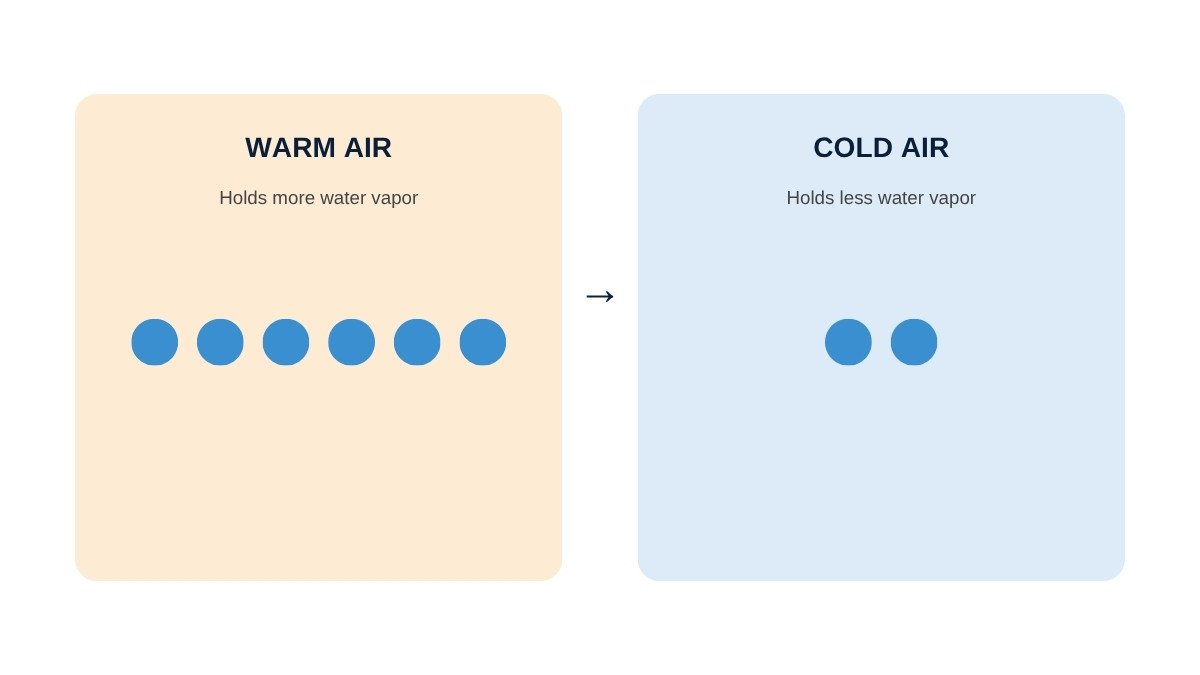
Relative humidity (RH) isn’t a direct measurement of how much water is in the air — it’s a ratio. It compares the actual amount of water vapor present to the maximum amount the air could hold at that specific temperature before becoming saturated. As the National Oceanic and Atmospheric Administration explains, warm air can hold more water vapor than cold air. That capacity — not the actual water content — is what shrinks as temperatures fall.
The National Weather Service puts it plainly in its public explainer on humidity: if the actual moisture in the air (its dew point or absolute humidity) stays the same, relative humidity will be highest when the air is coolest and lowest when the air is warmest. Flip that around for a cold snap: as the mercury drops and the air’s capacity to hold moisture shrinks faster than the moisture itself is removed, you’d actually expect RH to rise in a sealed, unheated space. But that’s only half the story — because almost nothing about your home stays sealed and unheated once a cold front moves in. For a deeper dive into the distinction between how much water vapor is present and what the percentage on your hygrometer actually means, see our guide to relative humidity vs. absolute humidity.
Why This Matters Both Outside and Inside Your Home
Outdoors, cold autumn air masses typically form over cool land or ocean surfaces and simply start out carrying less total water vapor than the warm, humid air of late summer. Less absolute moisture in the air mass means lower dew points, and lower dew points translate to a drier “feel” even before any heating system gets involved.
Indoors, the effect gets amplified. When outdoor air at, say, 40°F and 70% RH infiltrates your house and warms up to 70°F, the actual amount of water vapor it carries doesn’t change — but its capacity to hold moisture increases dramatically as it warms. The result: that same air might now register as only 20-25% RH inside your living room. This is why so many homes feel noticeably drier the moment fall heating season begins, even on days that don’t feel “cold” yet.
The Autumn Heating Effect: How Your Furnace Compounds the Problem
Turning on the furnace for the first time each fall doesn’t add any moisture to your indoor air — it just raises the temperature of the moisture-poor air that’s already there. Researchers at the University of Wisconsin–Madison’s Space Science and Engineering Center describe this clearly: as cold outdoor air enters a heated home and warms up, its relative humidity drops because “the maximum amount [of water vapor air can hold] is a function of temperature,” and heating widens the gap between the dew point and the indoor air temperature (The Weather Guys, UW–Madison).
In practice, that means every degree your thermostat climbs during a cold snap pushes your indoor RH lower, compounding the drop that’s already happening outside. This is the combination that catches a lot of homeowners off guard each fall: it’s not just that the weather turned cold — it’s that heating the house to compensate makes the air even drier than the outdoor numbers alone would suggest.
What Counts as “Too Dry”? The EPA’s Indoor Humidity Guidelines
The U.S. Environmental Protection Agency recommends keeping indoor relative humidity between 30% and 50%, and never letting it stay above 60% for extended periods, in order to protect health, comfort, and the building itself (EPA, Moisture Control for Schools). That upper limit gets most of the attention because of mold risk, but the lower bound matters just as much once fall heating season sets in. Falling below roughly 30% RH is when dry-air symptoms typically start to show up. Our full breakdown of that range — including why it shifts slightly by season and climate — is in our guide to the ideal indoor humidity level.
Signs Your Indoor Air Is Already Too Dry This Fall
- Static shocks when you touch doorknobs, light switches, or other people
- Dry, itchy skin, chapped lips, or a scratchy throat that improves once you leave the house
- Houseplants that need more frequent watering or develop crispy leaf edges
- Wood furniture, floors, or doors that start to creak, shrink, or gap slightly
- A hygrometer reading that has quietly slid from the 40-50% range into the 20s or low 30s
If several of these sound familiar, it’s worth checking a dedicated hygrometer rather than guessing — indoor RH can drop gradually enough that you adjust without noticing. We cover what to look for in our guide to choosing a hygrometer for your home, and if you’re seeing more dramatic symptoms, our list of signs your home has low humidity goes into more detail on each one.
How to Track the Drop as Temperatures Fall
Because the relationship between outdoor temperature and indoor RH is so direct, a cheap digital hygrometer placed in a common living space (away from direct sunlight, vents, or exterior doors) is the easiest way to see the effect in real time. Watch it over the course of a single cold front: as outdoor temperatures fall and your heating system kicks on more often, you should see the indoor percentage drop in near lockstep. That pattern is expected — it’s the same physics discussed above, not a sign anything is malfunctioning.
Quick Fixes for Autumn Low Humidity
- Run a humidifier sized for the room or your whole HVAC system, targeting the 30-50% EPA range rather than guessing.
- Lower the thermostat slightly where comfortable — since less aggressive heating means a smaller RH drop for the same outdoor conditions.
- Reduce unnecessary ventilation like long showers with the bathroom fan running or windows cracked on mild days, which can vent moisture you’d rather keep.
- Recalibrate expectations, not just your hygrometer — a reading in the low 30s on a cold, freshly-heated day is normal; the goal is to keep it from sliding further, into the teens or 20s.
Understanding why humidity drops when it turns cold outside won’t change the physics, but it does mean you can plan for fall and winter heating season instead of being surprised by it — and start monitoring and adjusting before dry air starts affecting your health, your home, or your houseplants.
Frequently Asked Questions
Why does relative humidity drop when the temperature drops outside?
Relative humidity compares the actual water vapor in the air to the maximum it could hold at that temperature. Cold air has a lower capacity to hold water vapor than warm air, so when a cold front brings in an air mass with less total moisture, both the absolute and relative humidity outdoors tend to fall.
Why does my house feel so much drier once I turn the heat on?
Heating doesn’t add moisture to the air, it only raises its temperature. As cold, moisture-poor outdoor air enters your home and warms up, its capacity to hold water vapor increases sharply while the actual moisture content stays the same, so its relative humidity drops — often into the 20-30% range or lower.
What is cold air low humidity and why does it happen indoors too?
Cold air low humidity refers to the reduced moisture-holding capacity of cold air. Because cold air simply cannot carry as much water vapor as warm air, both outdoor air during a cold snap and indoor air heated from that cold air end up with low relative humidity, even though no moisture was removed.
What indoor humidity level should I aim for in fall and winter?
The EPA recommends keeping indoor relative humidity between 30% and 50%, and avoiding sustained levels above 60%. During cold weather, the practical goal is usually to keep indoor RH from falling below roughly 30%, since going much lower is when dry-air symptoms like static shocks and dry skin tend to appear.
Does a humidifier actually fix the low humidity caused by cold weather?
Yes. A humidifier adds water vapor back into the air, raising the dew point and therefore the relative humidity at your indoor temperature. Sizing it to your room or whole-home HVAC system and targeting the 30-50% EPA range is more effective than running it on a fixed, arbitrary setting.
Will humidity naturally go back up once winter ends?
Yes. As outdoor temperatures rise in spring, warmer air masses carry more moisture and heating systems run less often, so both outdoor and indoor relative humidity typically climb back toward more comfortable levels without any special intervention.